
Copper Gutters
We install copper on four kinds of homes around town:
Older homes downtown and in the established neighborhoods. If your house was built before the 1950s, white aluminum gutters fight the architecture. Copper is what was originally there on a lot of these homes, and on brick, stone, and painted clapboard it looks correct instead of applied.
Homes with exposed rooflines you actually see from the street. Copper half-round gutters hung on cast fascia brackets read as trim, not as a rain accessory. If your gutters are visible from the curb, this is the upgrade with the most visual return.
Homes with cedar shake or slate roofs. Both outlast aluminum by decades. Putting a 20-year gutter under a 60-year roof means tearing the gutter off and redoing it mid-life.
Owners who are done with the replacement cycle. If you plan to be in the house for the long haul, or you are handing it to family, copper ends the conversation.
We will tell you this on site, but you may as well know now:
We will tell you this on site, but you may as well know now:
Solid copper. Sheet copper, either 16 oz or 20 oz, formed into gutter. Joints are soldered. Hangers, screws, outlets, downspouts, and elbows are all copper or brass. This is what we install.
Copper-plated or “copper penny” aluminum. Unlike standard aluminum or real copper, this uses aluminum coil with a copper-colored paint finish. It will never patina. It will fade like any painted aluminum. It costs roughly what standard aluminum costs. It is a legitimate product if you want the color cheaply — just know what you are buying, and do not pay copper prices for it.
Galvalume or steel with a copper-tone coating. Same situation. It is coated steel, not copper.
If a contractor quotes you “copper gutters” and the number looks low, ask whether the joints are soldered and whether the hangers are copper. Those two answers tell you everything.
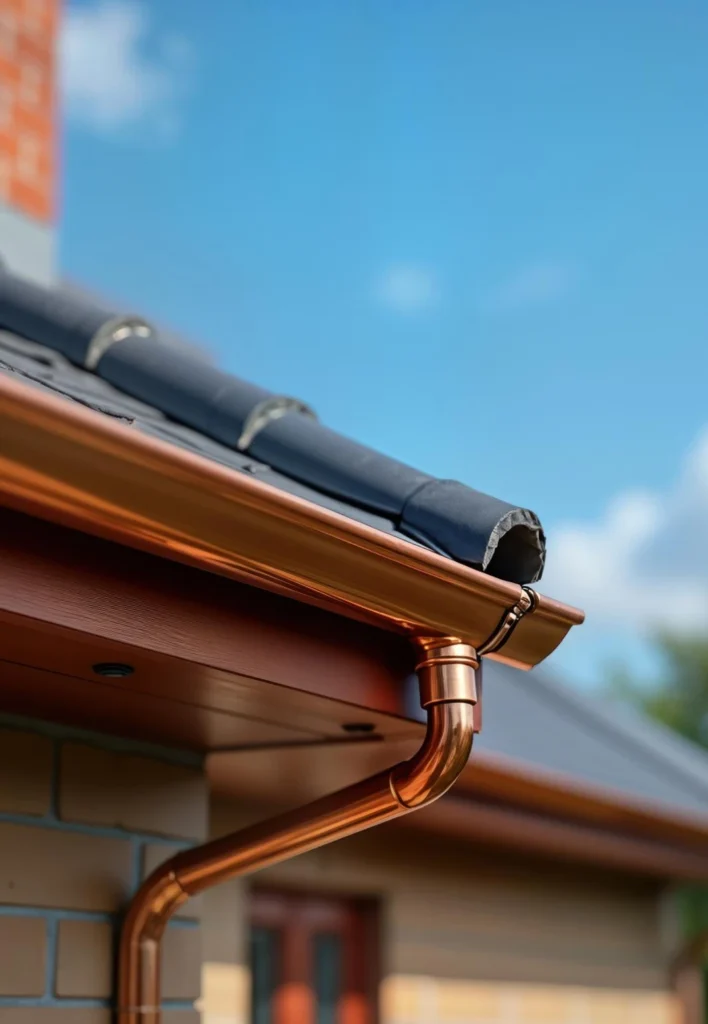
Half-round carries less water than K-style at the same nominal size. On a steep roof in this rainfall, that matters — which is why we often move half-round copper jobs up to 6 inch. More on sizing below.
This is one of the biggest differences between a copper gutter that lasts 80 years and one that leaks in eight. Seamless gutters eliminate joints along the long, straight sections, but corners and outlets still need to be connected and sealed.
Aluminum gutters typically use caulk at these points. Caulk is a consumable. In the Texarkana temperature swing — 20°F on a January morning to a surface temperature well over 140°F on a July afternoon — the metal moves, the sealant works, and eventually it splits. You re-seal it every several years.
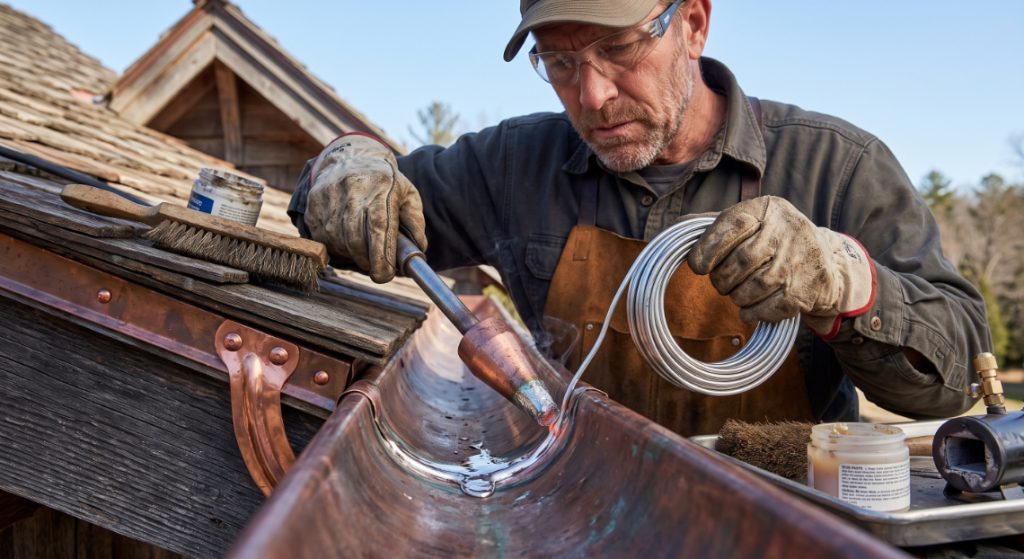
Copper is soldered. The joint becomes a continuous metal bond. There is nothing to dry out and nothing to re-apply. We solder:
Solder is a slower, hotter, more skilled process than running a bead of caulk. It is a real part of why copper costs what it does. It is also the entire reason copper is worth it. A riveted-and-caulked copper gutter is a copper-priced aluminum gutter. Ask any contractor bidding your job whether they solder.
Put copper in direct contact with aluminum, galvanized steel, or zinc in the presence of water, and you set up a small battery. The less noble metal corrodes, fast. In our humidity, with 50-ish inches of rain a year, there is essentially always water present.
Practically, on your house, that means:
This is not a detail you can inspect from the ground, and it is not something a crew that mostly hangs aluminum will necessarily get right. Ask.
Copper does not stay bright. This is the thing homeowners are most often surprised by, so here are honest timelines for an inland, humid climate like ours. Coastal homes patina much faster than we do, and most of the pretty green photos online are coastal.
Stage | Look | Roughly when, in our climate |
|---|---|---|
New | Bright salmon-pink, shiny | Day one |
Early oxidation | Darkening to russet and bronze | 6 months to 2 years |
Mature bronze | Deep chocolate brown, matte | 3 to 10 years |
Green patina begins | Streaked green appearing on weather-facing runs | 12 to 20+ years |
Full verdigris | Even green | Often 25 years or more inland, and sometimes never fully |
Two things to be ready for:
Water running off new copper carries dissolved copper, and it leaves blue-green streaks on light-colored surfaces. On this street that usually means:
Staining is heaviest in the first few years while the surface is actively oxidizing, and it eases as the patina stabilizes. We plan downspout locations and discharge points around it, but you should know it is a real trade-off before you commit. On a white-painted porch, it is a genuine consideration.
Gutters are sized to rainfall intensity, not annual rainfall. What matters is how much water hits your roof in the worst five minutes, not how much falls in a year.
Texarkana sits in the Gulf-fed rainfall belt. Our storms are short and violent — the spring severe season and the remnants of Gulf systems in late summer both deliver the kind of downpour that overwhelms a gutter that was sized off a national default. A 5 inch gutter with a 2×3 downspout is a perfectly reasonable system in a lot of the country. Here, on a steep roof with a long run, it overshoots.
How we size a copper job:
If a copper bid does not mention roof area, pitch, or downspout sizing, it is a price on linear feet, not a design.
Heavy, high-intensity rain. Copper handles it fine as a material. Sizing is what matters — see above.
Ice and freezing rain. We do not get northern-style snow, but we get ice storms, and ice is the load that pulls gutters off houses here. A trough packed with frozen slush is enormously heavy. Copper’s advantage is that soldered joints do not split under that stress the way caulked seams do, and we can spec heavier hanger spacing. Copper’s disadvantage is nothing — it is genuinely better in ice than aluminum.
Heat and UV. Copper has no finish to fade or chalk. Painted aluminum in full west sun in this climate will lose its color long before the metal fails. Copper just gets darker.
Hail. Honest answer: copper dents. So does aluminum, and more easily. Neither is hail-proof. Dents in a gutter are cosmetic and do not affect function, but if you are filing a storm claim, note that copper’s replacement cost is much higher — which is worth a conversation with your carrier before installation, not after.
Pine needles. The regional gutter problem, and copper does not solve it. Loblolly pine needles mat into a thatch that water will not flush out. Copper troughs clog exactly like aluminum ones. If you have pines over the house, budget for guards or cleaning as part of the project — see leaf covers and gutter helmets and gutter cleaning.
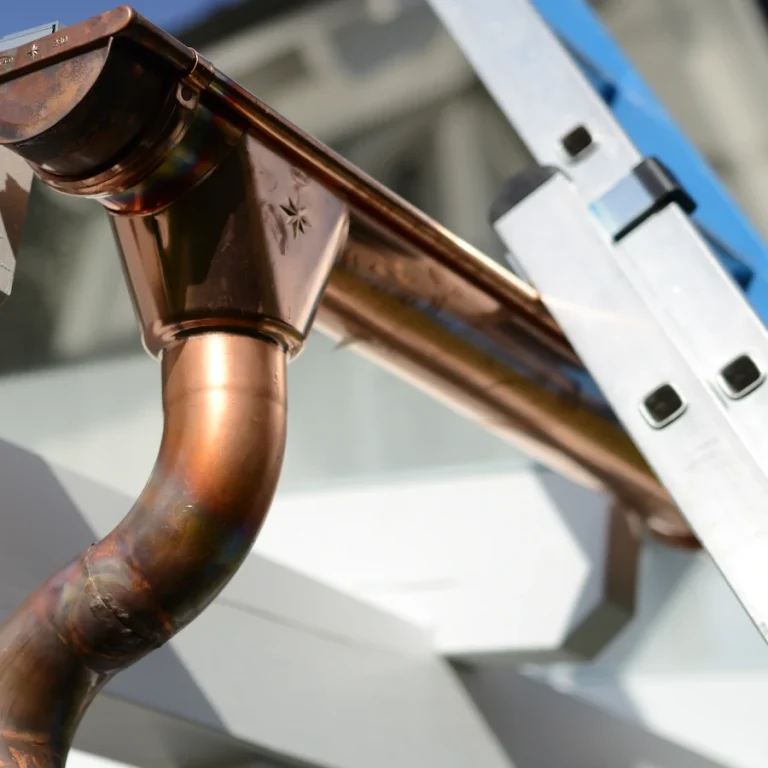
Straight answer: copper runs roughly 3 to 5 times the installed cost of seamless aluminum.
What drives the number on your house:
We quote copper on site, in person, with measurements. We do not quote copper over the phone, because a phone number on a copper job is a guess and you will end up arguing about a change order.
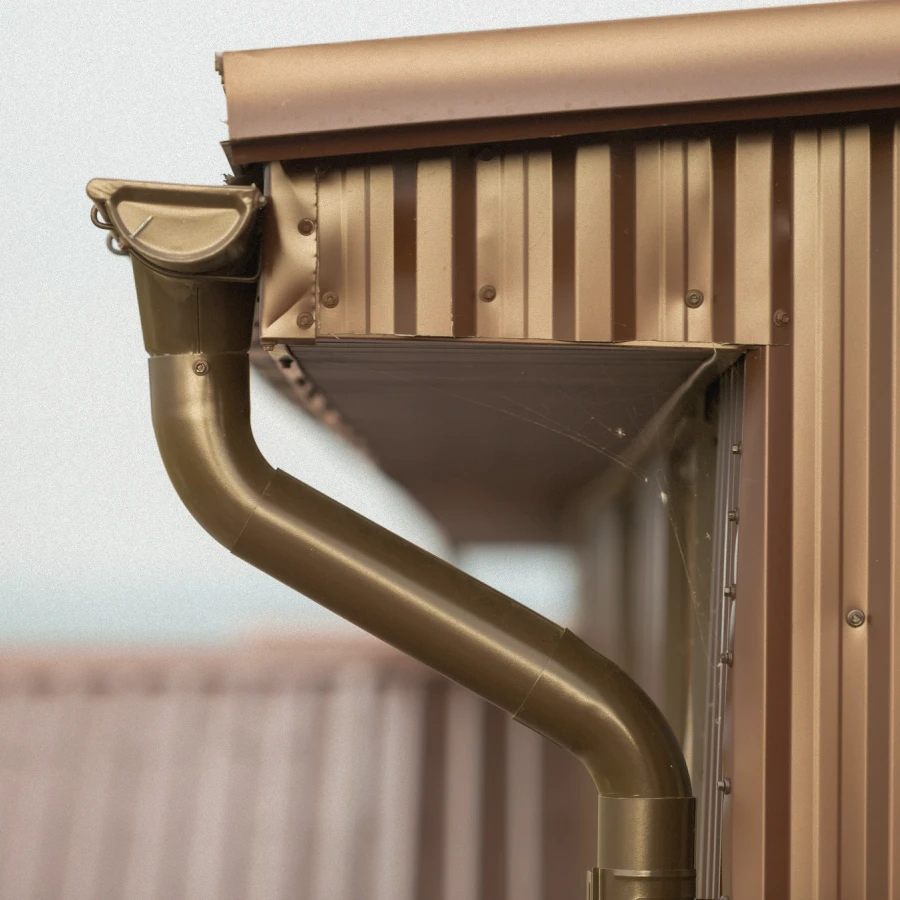
Full detail on how we handle sizing, pitch, hangers, and drainage is on our gutter installation page.
Texarkana sits on expansive clay. Clay swells when it is wet and shrinks when it dries, and that movement is what cracks slabs, sticks doors, and splits brick around here. Dumping roof water next to the foundation is one of the most expensive mistakes a house can make — and foundation repair costs multiples of what a gutter system costs.
Clay also drains badly, which means the easy answer of burying a corrugated pipe and forgetting it often just creates a saturated trench against the footing.
So on copper jobs we plan discharge deliberately: adequate extensions, proper grade, and where a buried line is the right call, a line with real fall and a pop-up emitter placed well away from the house.
For homeowners looking beyond copper, our other gutter services offer additional ways to manage roof runoff and protect the home.
Copper is low maintenance, but it still needs some care over time. If you want to reduce that maintenance, gutter helmets can help keep leaves and debris out and limit buildup in the system.
Posted on Google
 Pam Sprinkle
Trustindex verifies that the original source of the review is Google.
Excellent install and cleanup. If you want it done right the first time call Springbank Seamless Gutter!