
Most failed gutters in this area were not installed badly. They were installed generically — a 5 inch trough with 2×3 downspouts, the default that works fine across most of the country, put on a steep roof in a place that gets short, violent, Gulf-fed downpours.
Then the homeowner watches water sheet over the front edge in a spring thunderstorm and concludes the gutters are clogged. Sometimes they are. Often they are just too small, pitched wrong, or short a downspout.
Installation here is a sizing problem before it is a labor problem. This page explains how we approach it.
Repair is usually the right call for: a single leaking corner, one sagging section, a few pulled hangers, a separated downspout, or damage confined to one run.
Replacement is the right call when:
Regular maintenance can also help extend the life of your gutter system. Professional gutter cleaning can help keep gutters and downspouts clear of debris, while regular checks for leaks, loose hangers, or drainage issues can catch small problems before they turn into larger repairs or premature replacement.
We will tell you which one you are looking at. If a repair genuinely gets you five more years, that is what we will quote.
This is the part that separates a designed system from a price per foot.
Gutters are sized to rainfall intensity — how much water arrives in the worst five minutes of a storm — not to annual rainfall. Texarkana’s problem is not that we get a lot of rain over a year, though we do. Our problem is that a lot of it arrives at once, during spring severe weather and during the Gulf systems that reach us in late summer and fall.
Once the gutter system is properly sized for the roof and local rainfall, add-ons such as gutter guards and leaf covers can provide extra protection by reducing debris buildup and helping keep water flowing freely.
The water a gutter has to carry depends on the roof area draining into it and how steep that roof is. Pitch matters a great deal: a steep roof throws water at a gutter faster and behaves, for sizing purposes, like a considerably larger flat roof. Two houses with identical gutter footage can need different systems because one has a 4:12 roof and the other has a 10:12.
We calculate area per run, apply a pitch factor, and size from there.
The water a gutter has to carry depends on the roof area draining into it and how steep that roof is. Pitch matters a great deal: a steep roof throws water at a gutter faster and behaves, for sizing purposes, like a considerably larger flat roof. Two houses with identical gutter footage can need different systems because one has a 4:12 roof and the other has a 10:12.
We calculate area per run, apply a pitch factor, and size from there.
This gets overlooked constantly. A gutter can only get rid of water as fast as its outlets let it leave.
If a bid you are comparing does not specify downspout size and count, you do not have a comparable bid.
Gutters are sized to rainfall intensity, not annual rainfall. What matters is how much water hits your roof in the worst five minutes, not how much falls in a year.
Texarkana sits in the Gulf-fed rainfall belt. Our storms are short and violent — the spring severe season and the remnants of Gulf systems in late summer both deliver the kind of downpour that overwhelms a gutter that was sized off a national default. A 5 inch gutter with a 2×3 downspout is a perfectly reasonable system in a lot of the country. Here, on a steep roof with a long run, it overshoots.
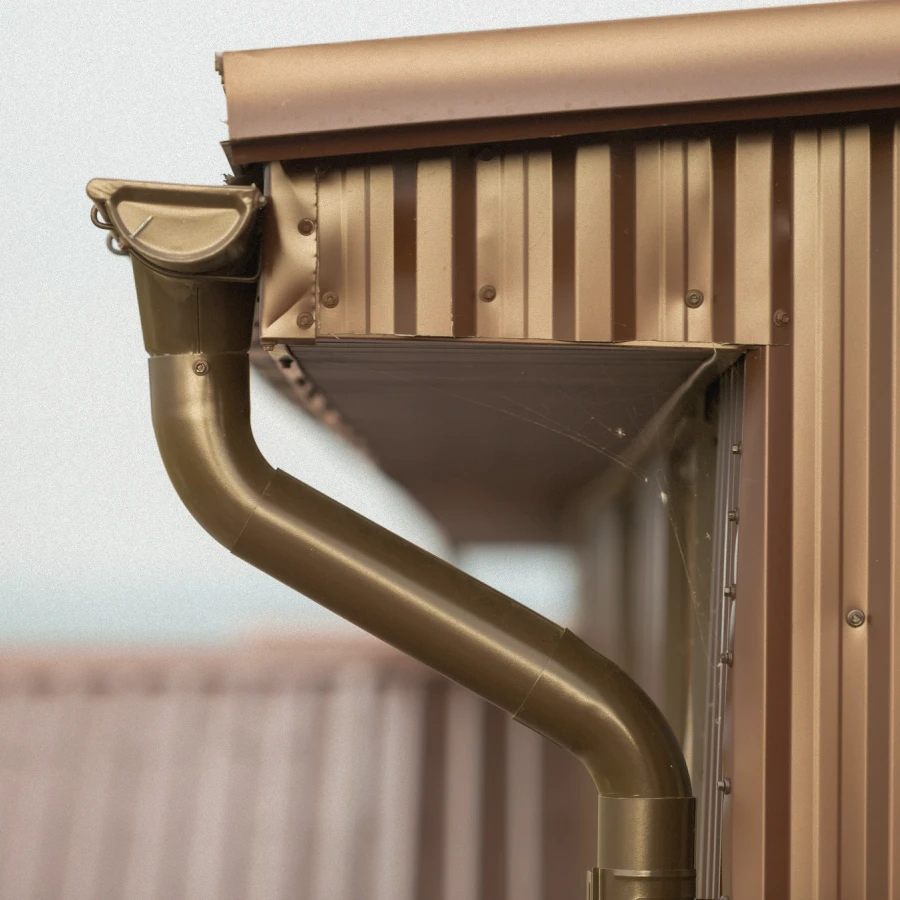
How we size a copper job:
A gutter has to fall toward its outlets. Too little and it holds water and debris; too much and it looks wrong against the fascia line and the water outruns the outlet.
We set a consistent fall toward each downspout — enough to drain fully and stay self-flushing, shallow enough to look level from the ground.
We hang on hidden hangers fastened with screws into solid fascia. Every time.
Spikes and ferrules are the old method: a long nail driven through the front of the gutter, through a sleeve, into the fascia. They fail here specifically because our humidity swings make the fascia wood expand and contract, which works the nail loose. Screwed hangers do not have that failure mode.
Standard spacing is adequate in mild climates. We tighten it up here because of two loads:
Aluminum expands and contracts noticeably with temperature. In this climate a gutter can go from a 20°F January morning to a surface temperature well over 140°F on a July afternoon. Across that swing, a long run of aluminum moves a measurable fraction of an inch — enough to work sealant loose at a rigid joint and enough to buckle a run that has been pinned hard at both ends.
Practically: long runs need to be detailed to allow movement rather than fight it. This is one of the quiet reasons cheap installs start leaking at the corners in year three.
Water has to get from the roof into the gutter, not behind it. Where drip edge is missing, damaged, or terminates short, water runs down the fascia instead — which is how fascia rots even on a house with clean gutters. We check it and address it as part of the job.
Where a roof edge meets a wall — around dormers, over garage returns, at bump-outs — water needs to be kicked out into the gutter instead of allowed to run down inside the wall. Missing kick-out flashing is a top cause of hidden wall and sheathing rot, and in our humidity that damage does not dry out. We flag it.
Your gutter is only as solid as the board it is screwed to. In this climate, wet fascia does not dry, and soft fascia will not hold a screw under an ice load.
On every install we:
We do not hang new gutters on rotted fascia. It is the single most common corner cut in this trade and it guarantees a callback.
This is the highest-stakes part of a gutter job in Texarkana and the part most often ignored.
The problem: this region sits on expansive clay. Clay swells when it is saturated and shrinks when it dries. That movement is what cracks slabs, sticks doors, and separates brick around here. Dumping the roof’s water next to the foundation puts one section of soil into a permanent wet-dry cycle while the rest of the perimeter stays stable — and uneven movement is what actually damages a foundation. Foundation repair costs many multiples of a gutter system.
The complication: clay drains slowly. The intuitive fix of burying a corrugated pipe and forgetting about it often just creates a saturated trench against the footing — worse than a splash block.
What we do:
If you already have foundation movement, gutters and drainage are the cheapest thing you can do to stop it getting worse. They will not reverse what has happened.
Typical timeline: Most residential gutter projects follow a straightforward schedule, but complex rooflines, significant fascia repairs, or buried drainage can add time. For additional gutter needs, explore all our gutter services to find the right solution for your property. Weather may also affect the schedule, especially in spring.
Posted on Google
 Pam Sprinkle
Trustindex verifies that the original source of the review is Google.
Excellent install and cleanup. If you want it done right the first time call Springbank Seamless Gutter!Posted on Google Matt SmithFantastic builderPosted on Google
 Lee EnszThese are good people. They will do what they say and stand behind their product!!!Posted on Google
 Mike ShortOutstanding jobPosted on Google
 DEIDRA BENNETTLes and his guys were very professional. They showed up when they said they would. I am looking forward to not needing gutters cleaned. Highly recommend!Posted on Google
 Kelly KelnerGreat job, fast friendly crew. Bid for work was easy to understand and work was executed accordingly. Cleaned up everything! It was as if they were never there and left nice me gutters that actually do the job. Never have to clean a gutter again. Gutter helmet is the way to go! Thanks, KellyPosted on Google
 clay JantzenQuality work!Posted on Google
 casey johnsonThese guys do a fantastic job at a competitive price. Highly recommended!
We install in Texarkana TX and Texarkana AR, plus Wake Village, Nash, New Boston, Hooks, Redwater, Maud, Leary, Queen City, Atlanta, De Kalb, Genoa, Fouke, and Ashdown.
FAQ